Why Most Die Castings Cannot Be Anodized (and Which Alloys Can)
Opening: The Sentence That Comes Up Every Month
“We need an aluminum die casting, anodized finish, material ADC12.”
That sentence shows up constantly on quotations and drawings, but it contains a physical contradiction: ADC12 is the most widely used die casting aluminum alloy in the world, and at the same time one of the least suitable alloys for anodizing.
The failure is not a question of how good the anodizing shop is, and no number of extra process steps will rescue it. The composition and the process pull in opposite directions — ADC12 gets its strength from silicon and copper, and silicon and copper are exactly what anodizing cannot tolerate.
Behind this sits a cost calculation. If it works, unit cost drops far below a part milled on a CNC, and the appearance comes close to extruded profile. If it does not, the money goes in the wrong direction — changing anodizing shops, adding polishing, pushing film thickness — all of it wasted.
What follows covers: why it fails, under what conditions it works, which alloys work, how the numbers actually add up, and what a wrong choice costs.
1. What Anodizing Actually Does
Immerse the aluminum part in dilute sulfuric acid and pass current through it, so that the surface grows its own layer of aluminum oxide (Al₂O₃). The film is ceramic in nature: hard, wear-resistant, dyeable, and because it grows out of the substrate it does not peel off in sheets the way paint does.
The key phrase is “grows out of the substrate” — the film is made of aluminum atoms that were previously part of the metal.
From which follows one hard rule:
Only aluminum can grow this film. Every other element in the substrate either takes no part in the reaction (and stays in the film as a defect) or breaks down the structure of the film.
ADC12 runs roughly as follows:
| Element | Content | What it does here |
|---|---|---|
| Si | 9.6–12% | Improves fluidity, suppresses hot tearing, raises hardness and wear resistance |
| Cu | 1.5–3.5% | Raises strength and hardness, improves machinability |
| Fe | 0.7–1.1% | Prevents die sticking |
| Balance | Mostly Al | The substrate |
In other words, more than a tenth of ADC12 is silicon and about two points are copper. Those two elements are where its strength comes from, and they happen to be the two weakest points for anodizing.
2. Four Obstacles, Each With a Concrete Consequence
Obstacle 1: Silicon Does Not Oxidize — It Stays in the Film as Grey Spots and Black Patches
Silicon takes no part in the reaction under anodizing conditions, and it does not conduct. The result:
- No current passes around the silicon phase, so that patch never grows a film
- Silicon particles are lightly attacked by the electrolyte and stand proud of the surface in a grey-black tone
- The coarser the silicon phase — exactly what as-cast, unmodified alloy gives you — the more visible the defect
What you see: a grey or black cast to the surface, pitting, white spots, a discontinuous film. A dark color can just about hide it. Natural or light colors are not viable at all.
Obstacle 2: Copper Darkens the Film and Drags Corrosion Resistance Down
Copper dissolves into the electrolyte during anodizing, and part of it re-deposits into the film in an extremely fine form. Two consequences:
- Color: the film shifts from silver-white toward a dull dark red, and light colors are out of the question
- Corrosion: copper is a cathodic phase and forms micro-cells inside the film, so salt spray hours drop sharply
Rule of thumb in the trade: above 0.5% Cu the deterioration becomes obvious; above 2% appearance-grade anodizing is essentially over. ADC12 at 1.5–3.5% sits in the second group.
Obstacle 3: Porosity Does Not Conduct, So No Film Grows There
Die castings contain porosity both inside and near the surface; the more gas entrapment, the more pores. Anodizing depends on current — where a pore interrupts the conductive path, no film forms.
The visible sign is fine white or bright dots, sometimes whole areas that take no dye at all. The worse problem is the after-effect: during anodizing, dyeing and sealing, those pores trap acid and dye. Nothing shows at dispatch, then weeks or months later white powder bleeds out at the customer, or the color shifts — the most common complaint on anodized die castings, and almost impossible to rework.
Obstacle 4: Only the Outer 0.3–0.8 mm Is Actually Dense
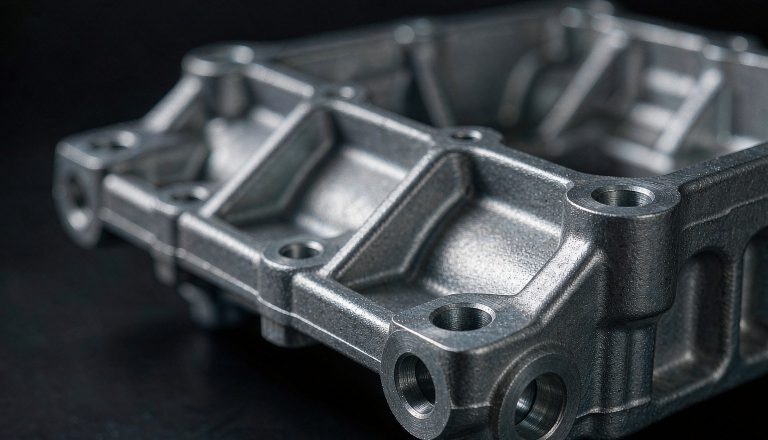
During casting, the metal that touches the die surface is chilled rapidly and forms a fine-grained dense skin. Behind it lies a porous zone, and the deeper you go the more porosity there is.
Which creates one hard constraint:
Machining stock removal must not exceed the thickness of the dense skin. Once the cut reaches the porous zone, anodizing will fail, and no anodizing shop can rescue it.
Most cases of “some parts in the same lot are fine, others are not” trace back to machining allowance fluctuating around that critical value — not to an unstable anodizing bath.
One Secondary Obstacle: Iron Phases
Iron in aluminum forms needle-shaped or Chinese-script Al-Fe-Si phases (β-Al₅FeSi). These phases do not anodize and are harder to attack than the aluminum matrix, so they stand proud after polishing and turn into pits or streaks after anodizing. The higher the Fe and the slower the cooling, the longer the needles.
3. When It Works: Three Conditions, All at Once
Whether a part can be anodized is not decided by the alloy designation, but by these three:
| Condition | Threshold | How to verify |
|---|---|---|
| Silicon content | Si ≤ 0.5% for light colors; ≤ 3% for silver-grey; > 8% dark colors only, with many defects | Material certificate |
| Copper content | Cu ≤ 0.1% essentially no effect; > 0.5% visibly dark; > 2% unusable | Material certificate |
| Dense-skin allowance | Machining removal < 0.3 mm, and no tool marks left on critical faces | Machining drawing plus a sectioned first part |
If any one of the three is not met, no amount of process tuning will fix it. Change the material, or change the surface finish.
4. The Four Alloy Routes That Work (with Relative Cost)
It is not that “some aluminum alloys can do it” but four distinct routes, each with its own trade-off:
| Route | Typical composition | Tensile MPa | Yield MPa | Elongation % | Hardness HB | Anodizing result | Casting difficulty | Relative cost |
|---|---|---|---|---|---|---|---|---|
| Conventional ADC12 (baseline) | Si 9.6–12, Cu 1.5–3.5 | 230–310 | 150–170 | 1–3 | 80–95 | Not usable for appearance | Baseline, very easy | Baseline |
| Low-silicon Al-Si-Mg | Si 1–3, Mg 0.3–0.6, Fe ≤ 0.2 | 240–290 | 120–150 | 8–12 | 60–80 | Silver-grey; dark colors work | Moderate, needs high vacuum | Medium-high |
| Al-Mg series | Mg 3–6, Si 1.8–2.5 | 270–320 | 160–190 | 10–18 | 65–80 | Bright silver-white; light colors possible | High, prone to sticking and hot tearing | High |
| Al-Mn series (recent route) | Mn 1–3, Mg 0.8–4.7, Si ≤ 0.45 | 250–300 | 160–217 | 9–13 | 60–75 | Full color range, controllable color spread | High, needs vacuum | High |
| High-purity Al 99.5 | Al ≥ 99.5 | 90–130 | 40–60 | 15–25 | 30–45 | Best; any light color | Moderate, very low strength | High |
The “relative cost” column has to be read together with three things: material price, material availability, and yield. Anodizing-grade alloy costs more than ADC12, and not every heat is consistent; yield is lower than standard die casting. Yet all three together still land far below the total cost of a CNC-machined part — which is what the next section is about.
A few notes:
First, low-silicon Al-Si-Mg is the best-value compromise. Strength sits at roughly 80% of ADC12, but elongation is four to six times higher, the anodized finish is a uniform silver-grey, and black, dark grey and dark blue are no problem at all. If the customer does not need a light color, this is the cheapest route.
Second, Al-Mg is the only route that matches ADC12 on strength while still allowing light colors. The price is poor castability — die sticking and hot tearing — so die temperature, release agent and gating all have to be rebuilt. Without the matching tooling and process experience, switching material will scrap a set of dies.
Third, Al-Mn is the newer direction. Published patent data shows as-cast yield of 160–217 MPa with elongation above 10%, while silicon is held at 0.15–0.45%. The significance: for the first time a die casting can keep structural-part strength and still get an anodized appearance close to wrought aluminum. But this route demands a step up in vacuum casting, composition control and returns management — it is not a drop-in alloy change.
Fourth, high-purity aluminum only suits parts where appearance is everything and strength is not required (decorative panels, lamp bezels, cosmetic caps). At 30–45 HB it carries almost no load.
5. How the Numbers Work: CNC, ADC12 Die Casting, Anodizing-Grade Die Casting
The conclusion first, because it is often computed backwards:
An anodizing-grade die casting costs more than an ADC12 die casting, but far less than a CNC-machined part.
Most people get this wrong by comparing it against ADC12. That is the wrong benchmark — it does not replace ADC12, it replaces the part that is milled from billet and then anodized.
Three cost items decide it:
1. Material Utilization
- CNC: milled from plate or extrusion; complex parts often lose 60–85% of the stock, so material utilization is only 15–40%. And the aluminum milled away is aluminum you already paid for.
- Die casting: near-net shape, 85–92% utilization, with runners and gates going back into the melt.
The disadvantage in material price is largely cancelled out here. The more complex the part and the more material that has to come out, the bigger the gap.
2. Cycle Time per Part
- CNC: 10–40 minutes per part, multiple setups, and complex free-form parts need several operations on top. Machine rate times time is the main cost item.
- Die casting: 30–50 seconds per shot, and one shot can fill multiple cavities.
Per-part labor cost can be an order of magnitude lower. That is the root of “the bigger the volume, the more obvious it gets” — CNC cost grows linearly with part count, while the marginal cost of die casting is essentially material plus a little energy.
3. One-Time Investment (Tooling)
- CNC: no tooling cost, but dedicated fixtures are needed.
- Die casting: a die has to be built — a one-time investment.
So low volume favors CNC and high volume favors die casting. The crossover can be calculated:
Break-even quantity = Tooling cost ÷ (CNC cost per part − die casting cost per part)Worked example (the figures illustrate the arithmetic only; this is not a quotation): tooling RMB 60,000, CNC RMB 100 per part, die casting RMB 45 per part, a difference of RMB 55 — break-even at about 1,100 parts. In other words CNC wins up to roughly 1,000 parts, the die casting advantage opens up beyond 2,000, and by 5,000 parts the gap is an order of magnitude.
In real projects the die-cast part is often less than half the CNC price, especially where the geometry is complex and a lot of material has to come out. If tooling cost can be credited back against an agreed volume, the crossover moves earlier still.
4. The Two Costs Most Often Left Out
Cosmetic surface preparation. A CNC part carries milling marks and has to be fully polished before anodizing; polishing is priced per part, depends on labor, and uneven polishing shows up as color variation. On a die casting the cosmetic face is formed directly by the die surface, so hand finishing is far lighter.
Yield. Anodizing-grade die castings run a lower yield than standard die casting (color spread, porosity, silicon spots). That is a real cost and it has to be in the number — which is also why not every die caster can run this route. CNC has its own yield account, in the other direction: thin-wall distortion and clamping marks.
5. When CNC Still Wins (Honestly)
- Volume under 1,000 parts
- Part size beyond the press tonnage
- Tolerances that need multiple setups to reach (a “cast plus finish machine” combination may still not be enough)
- Very simple geometry (a plate with a few holes — the tooling never pays back)
- Very short lead time (CNC first part in days; die casting needs die build, trials and samples)
These are written out not to turn business away, but because the person asking for a quote knows their volume better than anyone. State the boundary first, and they trust what comes after it.
6. Why the Finish Gets Close to Extruded Profile
One admission first: for anodizing alone, 6063 extrusion is still the best substrate. No silicon, very little porosity, uniform grain, and a natural finish that can be made clear silver-white.
But extrusion has a hard physical limit: constant cross-section only. A profile has the same section from one end to the other, so variable section, curved surfaces, undercuts, internal cavities and three-dimensional shapes are all out.
What happens in practice is “extrude a blank, then mill the structure” — which puts you straight back at CNC cost, and actually above it, because you have paid for the extrusion as well.
That is why so many “extruded profile anodized” quotes are not cheap: the profile is cheap, the machining center behind it is not.
Die casting solves three things at once:
- Shape: complex free-form geometry, undercuts and three-dimensional structure in one shot, with no secondary milling to create the form
- Substrate cleanliness: low-silicon anodizing-grade alloy (Si ≤ 0.45%) plus vacuum casting (gas is drawn out of the cavity and porosity drops markedly) brings the two main defects — silicon spots and white spots — down into an acceptable range
- Surface condition: formed directly by the die, no milling marks, so no full polishing before anodizing
The result is an appearance close to extruded-profile color anodizing (dark and mid tones are the most stable), with a freedom of geometry and a cost that the “extrude plus CNC” route cannot reach.
The boundaries, stated plainly (which persuades better than a pitch):
- Light colors (champagne gold, light blue, pink) remain the hardest, with the highest color-spread risk; it depends on the specific part
- Maximum film thickness is lower than on extrusion, typically 8–15 µm
- Unit price is above an anodized extrusion (more expensive material, tighter yield), but far below a CNC part
- This is not “a cheaper extrusion” — it is a different route to shapes that extrusion cannot make
7. Color Is Not a Free Choice — the Alloy Decides It
This is the most commonly misunderstood point. Customers ask “can you do champagne gold” or “can you do light blue”; the answer depends not on the dye but on how clean the substrate is.
| Target color | Requirement on the substrate | Practical feasibility |
|---|---|---|
| Natural / silver-white | Si ≤ 0.3%, Cu ≤ 0.05% | Requires Al-Mg or high-purity aluminum |
| Light colors (champagne, light blue, pink) | Si ≤ 0.5%, Cu ≤ 0.1%, very low porosity | Requires high-purity aluminum or good Al-Mn |
| Mid tones (red, blue, green) | Si ≤ 3%, Cu ≤ 0.5% | Low-silicon Al-Si-Mg works |
| Black / dark grey / dark brown | Most forgiving | Most alloys other than ADC12 work, but porosity still has to be controlled |
The rule: the lighter the color, the more sensitive to impurities. Black works on “any alloy” only because a dark dye hides grey spots and color spread.
There is also a process ceiling: a thicker film is not a better film. Die castings are normally anodized at 8–15 µm; above 20 µm the internal stress of the film cracks it at pores and sharp corners, which then become corrosion initiation sites and salt spray performance falls. If you need wear resistance, choose hard anodizing (a denser film, not a thicker one) rather than simply adding thickness.
8. What You Trade Away
Switching to an anodizing-grade alloy has to be accounted for in full:
| Property | Change | Effect |
|---|---|---|
| Tensile strength | Slightly lower or unchanged | Usually irrelevant on cosmetic parts |
| Yield strength | Unchanged or higher | An advantage on structural parts |
| Elongation | Much higher (3–5 times) | Markedly better resistance to impact and to cracking at assembly |
| Hardness | Clearly lower (80–95 → 60–75 HB) | Threads, press fits and self-tapping points strip or crush more easily |
| Density | 3–5% higher in high-zinc systems | Lightweighting targets have to be recalculated |
| Thermal conductivity | Usually higher (low silicon helps) | A plus on heat-dissipating parts |
| Linear shrinkage | Higher than ADC12 (0.8–1.1% vs 0.5–0.7%) | The die may have to be remade or reworked — the largest hidden cost |
| Castability | Worse (die sticking, hot tearing) | Needs vacuum casting and die temperature control |
| Unit cost | Up versus ADC12; clearly down versus CNC | Different benchmarks give opposite answers — do not compute it backwards |
Hardness needs specific handling. A soft substrate is not a defect; it is the inevitable result of this alloy family — most of ADC12’s hardness comes from a coarse eutectic silicon skeleton, and anodizing-grade alloys have no silicon skeleton. The countermeasures sit in the design:
- Use threaded inserts instead of tapping directly into the casting
- Thicken bosses and increase the root fillet
- Replace self-tapping screws with machine screws and nuts
- Add bushings to interference-fit holes
- On wear surfaces, add hard anodizing or local coating
Shrinkage has to be confirmed before quoting. This is the cost that most often erupts at the production stage — the die is already built, the material change shifts every dimension, reworking the tool takes weeks, and the loss dwarfs the material price difference.
9. Choosing by Application: A Decision Table
| Application | Recommended route | Reason |
|---|---|---|
| Consumer electronics / appliance cosmetic parts, light color | Al-Mn series or high-purity aluminum | Color is the first requirement |
| Consumer electronics / appliance cosmetic parts, black or dark grey | Low-silicon Al-Si-Mg | Best value |
| LED lighting, heat sinks | Low-silicon Al-Si-Mg | Thermal conductivity is a plus, color demand is low |
| Telecom / security outdoor housings | Al-Mg series with thick film and sealing | Both strength and corrosion resistance are needed |
| Automotive non-load-bearing structural parts | Al-Mg or Al-Mn series | Yield strength and elongation both have to be adequate |
| Hardware trim, window and door fittings | Low-silicon Al-Si-Mg | Cost first |
| Complex cosmetic parts currently milled on a CNC | Low-silicon or Al-Mn plus vacuum casting | Geometry formed in one shot, cost amortized over volume |
| High strength + light color + high volume | Re-evaluate feasibility | All three at once is very hard; one usually has to give |
The last row is the honest one: if a customer wants ADC12 strength, high-purity aluminum color and standard die casting cost, those three cannot hold at the same time. The job then is to talk to the customer, not to go looking for a more capable supplier.
10. Eight Common Defects and Their Countermeasures
| Defect | Cause | Countermeasure |
|---|---|---|
| Grey or black surface | High silicon content, coarse silicon phase | Switch to low-silicon alloy; strengthen modification and refinement; if a dark color is acceptable, change the dye |
| Pitting and white spots | Porosity, inclusions, silicon phase pull-out | Raise vacuum level, improve degassing, control dross content |
| Discontinuous film, patches taking no dye | Porosity bands, cold shuts, incomplete degreasing before anodizing | Improve fill; add a desmutting step before anodizing |
| Color spread within a lot | Bath temperature fluctuation, contact resistance at the jig, substrate composition drift | Hold temperature to ±1 °C; change the jig; lock the heat number |
| Edge cracking and chipping | Film too thick, concentrated internal stress | Reduce film to 10–12 µm; increase corner radii |
| Late white powder bleed, color shift | Poor sealing, acid trapped in the pores | Improve rinsing; switch to nickel-salt or boiling-water sealing; raise vacuum level |
| Dark patches on machined faces | The cut has reached the porous zone | Reduce stock removal or change the machining datum |
| Salt spray failure | High copper, film not dense, poor sealing | Reduce copper, switch to hard anodizing, add sealing |
11. Eight Things to Confirm Before Ordering
Whether you develop the part in-house or buy it from a supplier, if any one of these eight is missing it will go wrong later:
- Full chemical composition, specifically the actual Si, Cu, Fe, Mg and Mn values — not the designation
- Whether the mechanical data comes from separately cast test bars or from the part itself — customers only accept the part
- Hardness test location and indenter specification (do not use HB 2.5/62.5 on thin walls)
- Measured linear shrinkage — decides whether an existing die can be reused
- Dense-skin thickness against machining allowance — decides which faces can be anodized
- The anodizing process window: bath concentration, temperature, current density, maximum film thickness
- A physical color sample, not a photograph of a color card
- Measured reports for salt spray, adhesion and sealing, including test standard and hours
Two more that are easy to forget:
- Anodizing reduces fatigue strength by 10–30% (brittle film, micro-cracks), so load-bearing parts need margin
- The film grows outward by about half its thickness — a 10 µm film adds 4–5 µm per side, so precision mating faces must be masked or machined after anodizing
Closing: Run the Numbers First, Then Change the Material
Back to the sentence at the start.
“ADC12 plus anodizing” is not difficult — it does not stand up. The composition rules out a serviceable cosmetic oxide film, and no change of supplier, budget or schedule will alter that.
What is actually worth calculating is a different question: is this part currently milled on a CNC?
If the answer is yes, then changing the material, building a die and going the anodizing-grade die casting route will in most cases bring unit cost down sharply, with an appearance close to extruded profile. If it is a few hundred parts, CNC still wins and there is no reason to churn.
The order has to be this:
- Run the numbers first — volume, material utilization, cycle time and tooling payback, all four together
- Then fix the material — light colors point to low-silicon or high-purity aluminum, strength points to Al-Mg or Al-Mn, and for dark colors only, low-silicon Al-Si-Mg is the best value
- Only then the process — the two knock-on effects, lower hardness and changed shrinkage, both go into the design and into the cost
What has to be done on the tooling and process side is covered in more detail in a separate article: Color Anodized Aluminum Die Casting: A Complete Mold and Process Solution.
Change the material first, then talk about process. In the wrong order you pay twice — once in money, once in time.
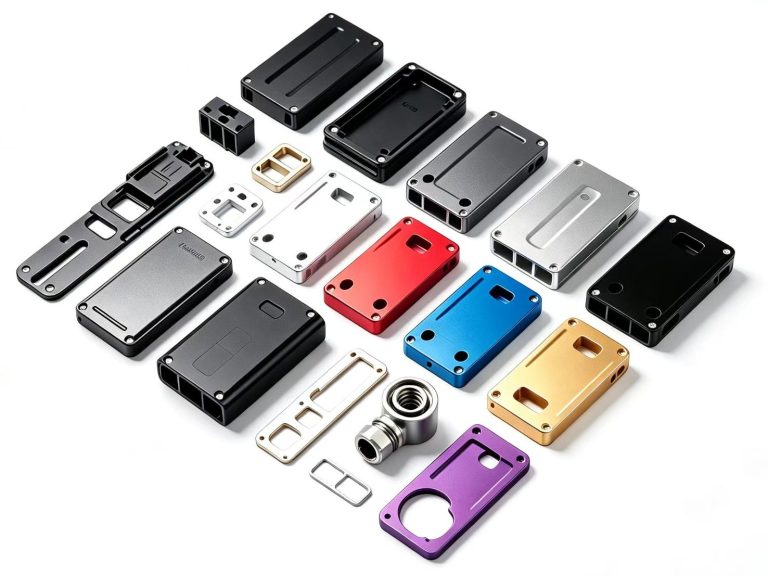
Among the anodized cosmetic parts we have run, representative examples are anodized electronic product housings and anodized aluminum cosmetic boxes.
If you have an aluminum part that is currently milled on a CNC, you can send us the drawing and we will run the per-part difference between die casting and CNC at your volume, then judge whether building a die is worth it.
Figures in this article come from published alloy data and measured values in recent aluminum die casting patents; for a specific project, rely on the measured reports your supplier provides. The cost example is included only to illustrate the arithmetic and does not constitute a quotation.